SCULPTURE

CHRISTINE BAXTER
ANNE-MARIE MARSHALL-FIEBER
CHRISTINE BAXTER
For me, sculpture is a medium for exploration and investigation. With conceptual sculpture, the medium is irrelevant – it is the idea being investigated that is important. Figurative work is often seen as merely representational.
Representation is an element, of course, but what I am most focused on is the emotional aspect. Whilst makin
For me, sculpture is a medium for exploration and investigation. With conceptual sculpture, the medium is irrelevant – it is the idea being investigated that is important. Figurative work is often seen as merely representational.
Representation is an element, of course, but what I am most focused on is the emotional aspect. Whilst making a piece I am consciously trying to explore and understand the emotions I have in response to it. I’m hoping to create a similar dialogue and emotional response from the viewer. This is my concept.
The part of the process I most enjoy is what happens once you’ve mastered the physicality of the clay and the likeness of the model. This is when it really gets interesting.

JULIAN COX MRBS
ANNE-MARIE MARSHALL-FIEBER
CHRISTINE BAXTER
Julian studied Sculpture Restoration for three years at Roger de Grey’s PRA, The City and Guilds of London Art School. Practical aspects of this course, which included a period of study in northern Italy, emphasized drawing, wood and stone carving, modelling, letter cutting, gilding and conservation/restoration techniques. He also did a P
Julian studied Sculpture Restoration for three years at Roger de Grey’s PRA, The City and Guilds of London Art School. Practical aspects of this course, which included a period of study in northern Italy, emphasized drawing, wood and stone carving, modelling, letter cutting, gilding and conservation/restoration techniques. He also did a Post Graduate Teaching Certificate at The University of London, Goldsmiths’ College, following which he taught Art and Design & Technology at a secondary school for nine years. In September 1998, he resigned his full time teaching post so that he could dedicate more time and energy to his own art.
ANNE-MARIE MARSHALL-FIEBER
ANNE-MARIE MARSHALL-FIEBER
ANNE-MARIE MARSHALL-FIEBER
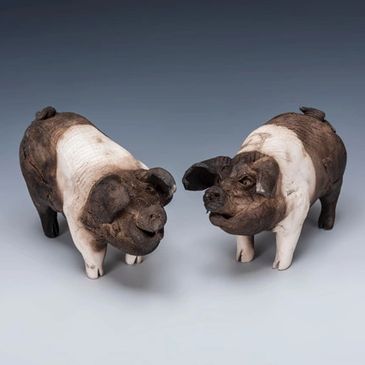
Anne-Marie has drawn and modelled animals from an early age. She gained a degree in ceramics from Middlesex University in 1992. She went on to set up her studio in the New Forest, where she was inspired by the animals around her.Her travels around the world enabled her to study wild animals first hand, particularly in Africa.Anne-Marie’s
Anne-Marie has drawn and modelled animals from an early age. She gained a degree in ceramics from Middlesex University in 1992. She went on to set up her studio in the New Forest, where she was inspired by the animals around her.Her travels around the world enabled her to study wild animals first hand, particularly in Africa.Anne-Marie’s more recent work is based on the domestic and wild animals that inhabit the Forest around her studio.Anne-Marie uses a variety of techniques to construct her work including slab building, press moulding, pinching and coiling. Interesting surface textures are achieved by experimenting with rolling the clay on a variety of materials.The pieces are coloured with oxides andunder glazes and fired up to 1200c.Anne-Marie’s work is constantly evolving, she shows her work in Galleries all over England.

LIZ FLOYD
HELEN GORDON
FRED GORDON
About nine years ago Liz started to make boats. The initiative was taken by the bits of wood and metal she had start to collect. Excitment set in when they seemed to belong together, they chose their own design.
She has found drift-wood in Cornwall and abroad, rusty bottle-tops from a South African township, copper wire in Greece and old b
About nine years ago Liz started to make boats. The initiative was taken by the bits of wood and metal she had start to collect. Excitment set in when they seemed to belong together, they chose their own design.
She has found drift-wood in Cornwall and abroad, rusty bottle-tops from a South African township, copper wire in Greece and old bits of metal in Spain. Every walk is an adventure. Her husband is excellent at spotting a treasure lurking in a hedge or on a burnt-out bonfire.
FRED GORDON
HELEN GORDON
FRED GORDON
Fred Gordon, born in 1993, graduated from the University of Edinburgh in July 2017 with a 2:1 MA (Hons) in French and History of Art, after having done a foundation diploma in Art and Design at Falmouth University. He has always been interested in some form of art and, despite being largely self-taught, Fred has been sculpting professiona
Fred Gordon, born in 1993, graduated from the University of Edinburgh in July 2017 with a 2:1 MA (Hons) in French and History of Art, after having done a foundation diploma in Art and Design at Falmouth University. He has always been interested in some form of art and, despite being largely self-taught, Fred has been sculpting professionally since 2011. Determined to pursue a career in wildlife sculpture, he was fortunate to secure a place with Animal Art Fair in London, exhibiting in their summer exhibition. He also took part in the Natural Eye Exhibition for the Society of Wildlife Artists and was, also, thrilled to be asked to take part in the SMA Trust Charity Auction Dinner in the National Gallery, London. Fred finished 2017 exhibiting at the Art for Youth London exhibition at the Mall Galleries and was awarded the much coveted Wates Foundation Diana Brooks Prize for new and emerging talent.
Having lived in the countryside all his life, Fred was exposed to and inspired by the natural world from an early age. To begin with, he primarily used drawing as a way of capturing the essence of his subjects. However, in 2011, influenced by his mother, he turned to sculpture, as he could better articulate the intricacies of the anatomy, and the movement inherent in the wildlife he observed. Fred uses quick and fluid gestures to capture the motion and vitality of the subject. Working first in clay or wax, the piece is then cast in bronze or bronze resin.
HELEN GORDON
HELEN GORDON
HELEN GORDON
Born in Warwickshire, I moved to the West Country, firstly to read European Studies at The University of Bath in 1981 and latterly, in 1994, to set up home with my family in The Chew Valley, where I remain to this day, having done a stint in London.
For the past ten years my focus has been sculpting, which I happened upon when I agreed to
Born in Warwickshire, I moved to the West Country, firstly to read European Studies at The University of Bath in 1981 and latterly, in 1994, to set up home with my family in The Chew Valley, where I remain to this day, having done a stint in London.
For the past ten years my focus has been sculpting, which I happened upon when I agreed to accompany a friend on a ceramics course for one afternoon a week at The Bristol School of Art. I was instantly hooked and have not looked back. Interest in my work grew and I began to start selling my pieces.
STUART HALL
GEORGE HIDER
GEORGE HIDER
Stuart Hall is a self-taught artist from Somerset. He was bought up in a small village Mark, went to school in Cheddar, studied in Bristol and still lives locally in Axbridge, a town at the foot of beautiful Mendip Hills. Stuart has been sculpting with a clay for 5 years and uses freehand style that he feels very comfortable with. He also specialises in commission pet dogs.
GEORGE HIDER
GEORGE HIDER
GEORGE HIDER
George has been working with recycled metal for over 25 years, creating lifelike bird and animal sculptures. He was brought up to make do and mend. Fourteen years in the Territorial Army showed him how to improve self-sufficiency. It was during the time spent in an engineering environment that he realised his ability to see sculptural mat
George has been working with recycled metal for over 25 years, creating lifelike bird and animal sculptures. He was brought up to make do and mend. Fourteen years in the Territorial Army showed him how to improve self-sufficiency. It was during the time spent in an engineering environment that he realised his ability to see sculptural material and shapes amongst the metal bound for the scrap bin: by welding together pieces carefully chosen from discarded steel, his sculptures have become increasingly more lifelike, capturing the character of the animals and birds which unwittingly model for him.
PIPPA HILL
GEORGE HIDER
PIPPA HILL
I am obsessed with clay. For as long as I can remember, I have been fascinated by it, digging it up from the fields when I was young and making things that rapidly fell to pieces. It is the only material I know that only needs hands to shape it.
Despite no formal opportunity to train in ceramics, I have always continued to make things out
I am obsessed with clay. For as long as I can remember, I have been fascinated by it, digging it up from the fields when I was young and making things that rapidly fell to pieces. It is the only material I know that only needs hands to shape it.
Despite no formal opportunity to train in ceramics, I have always continued to make things out of clay.
Each piece I make is entirely hand built. The animal sculptures include British wildlife, farm animals, dogs and cats. I also make other animals found further afield, such as rhinos, leopards or elephants. Apart from the ceramics, my work is available in Bronze resin and foundry Bronze..
She constructs sculptures from clay, plaster or wax.
Her tactile sculptures are all hand made in the UK each one an individual.
Michelle has a wide range of ceramic, bronze and Bronze resin sculptures, produced with a variety of glazes and textures.
SOPHIE HOWARD
SOPHIE HOWARD
SOPHIE HOWARD
Born in West Dorset in the late 1950s, Sophie grew up in Yorkshire and trained at Winchester Art School before moving to London and later returning to the West Country in 1987. She lives in Bristol and is a director of HOURS, a gallery and event space in the city.
Sophie makes evocative sculpture in her central Bristol studio. She collaborates with others - mould makers, casters and other artists to realise her designs and commissions.
Seeking to find her own voice she makes collections of pieces exploring themes including motion and stillness, the body, city life and animals.
CATHY JUDGE
SOPHIE HOWARD
SOPHIE HOWARD
Having always led an artistic and creative life I was introduced to sculpture by accident at an open day at Shute Farm Studios, near Shepton Mallet in the late ‘90s. It was there that I had my first life changing experience of creating a sculpture. I was instantly hooked and the following day rushed out to buy my first slab of clay. Hardly a day has passed since then that has not found me sculpting.
Sculpture is always a frustrating struggle to achieve the end result that one desires. The thrill of completion is addictive however and I find myself impatient to start the next piece.
My early untutored efforts were refined and expanded by formal study at Queens Road College of Art and Design, Bristol and also Bath City College.
My interest is in the geometry of the female form. When I view a figure I aim to look beyond the detail in order to capture its underlying patterns and rhythms. I enjoy expressing its lines, emphasising the tactile and curvaceous. My work is available in limited editions of both cold cast resin and bronze.
LUCY LARGE
SOPHIE HOWARD
LUCY LARGE
Lucy Large studied sculpture at Camberwell College of Art in London,
Her work is rooted in the handling of materials and an enjoyment of the theatre of the three-dimensional object.
Lucy makes bird sculptures from fine aluminium mesh, these include some works that are suitable for outdoor siting. She also makes detailed, hand-cut paper designs, often responding to the natural world.
WARREN LEAVENS
WARREN LEAVENS
WARREN LEAVENS
Working as the Little Paper Factory he creates individual pieces of art using recycled objects, materials and paper. This form of paper art, similar to origami originated in Japan and is known as Kirigami, and is best described as the folding and cutting of paper into decorative shapes. These individual pieces are then mounted in re-purpo
Working as the Little Paper Factory he creates individual pieces of art using recycled objects, materials and paper. This form of paper art, similar to origami originated in Japan and is known as Kirigami, and is best described as the folding and cutting of paper into decorative shapes. These individual pieces are then mounted in re-purposed objects such as printer trays, wooden boxes or anything else 'vintage' that appeals to the artist. Even the paper is recycled and ranges from old sheet music or newsprint to maps or perhaps the pages from an old copy of the Encyclopaedia Britannica. Everything is individually designed and handmade resulting in truly unique pieces of art.
DEREK SMITH
WARREN LEAVENS
WARREN LEAVENS
As a qualified cabinetmaker I have worked with wood since I left school so it was a natural progression to start carving the wildlife I enjoy so much. I use found woods mixed with other woods I have in the workshop/studio at any given time and I finish my work with acrylic paints and waxes. My carvings are what I see and observe in the ch
As a qualified cabinetmaker I have worked with wood since I left school so it was a natural progression to start carving the wildlife I enjoy so much. I use found woods mixed with other woods I have in the workshop/studio at any given time and I finish my work with acrylic paints and waxes. My carvings are what I see and observe in the characteristics of the subject and I do not emulated every detail as I like to add my own interpretation as I carve.
Derek is based near Saffron Walden, Essex.
COUNT UMBER
WARREN LEAVENS
COUNT UMBER
With two decades of experience as a caster and sculptor, Count Umber specialises in striking, original cold-cast pieces. These are not traditional works of sculpture, but have been designed to be picked up and turned over in the hands. Count Umber pieces are chunky, heavy and elegant. Each work from Count Umber is entirely cast and finish
With two decades of experience as a caster and sculptor, Count Umber specialises in striking, original cold-cast pieces. These are not traditional works of sculpture, but have been designed to be picked up and turned over in the hands. Count Umber pieces are chunky, heavy and elegant. Each work from Count Umber is entirely cast and finished by him. Every single cast is unique, with its own quirks and imperfections.
STEVEN WHIFFEN
STEVEN WHIFFEN
STEVEN WHIFFEN
My work is about the beauty, infinite complexity and preciousness of life and the delicate balance between chaos and order. My inspiration is drawn from the likenesses between microcosmic and macrocosmic forms such as subatomic particles and planets.
Each sphere is produced by eye and hand, often from rare and precious materials. I feel pe
My work is about the beauty, infinite complexity and preciousness of life and the delicate balance between chaos and order. My inspiration is drawn from the likenesses between microcosmic and macrocosmic forms such as subatomic particles and planets.
Each sphere is produced by eye and hand, often from rare and precious materials. I feel peaceful, meditative processes are ideal and choose hand tools whenever possible.
Many of these works take years to complete, as some media must be seasoned and finishing processes can require months of curing. Some have been stored for over a decade, in order for the desired patina to develop.
Often they include hidden elements, which usually have a property that makes them attractive to interact with. Under the right circumstances I like to encourage people to explore, even to play with my work.
SOPHY WHITE
STEVEN WHIFFEN
STEVEN WHIFFEN
I work with very simple images that come from our tribal past, when rock art was all we had between us and the wolf. Iconic animals - horses, deer, foxes, ravens - are woven into our folklore, and our collective unconsciousness.
We have a strong culture attached to the horse, and I've followed the thread of horses all my life, painting the
I work with very simple images that come from our tribal past, when rock art was all we had between us and the wolf. Iconic animals - horses, deer, foxes, ravens - are woven into our folklore, and our collective unconsciousness.
We have a strong culture attached to the horse, and I've followed the thread of horses all my life, painting them and working with them, alongside a professional career in dentistry.
In 2005 I gave up the dental practice to focus on art. Working in ceramics I've found interesting parallels between the technical challenges of glazes and firing and my early training in material sciences.
DINAH WYATT
STEVEN WHIFFEN
DINAH WYATT
Sheena Spacey's folk art ceramics and paintings are an antidote to the high-speed world we inhabit. They’re innocent, simple and reassuring. "I like my work to evoke a sense of nostalgia for quiet days gone by, where home and storytelling offer comfort and a haven from the hustle and bustle of everyday living,"